Tuesday, October 22, 2024

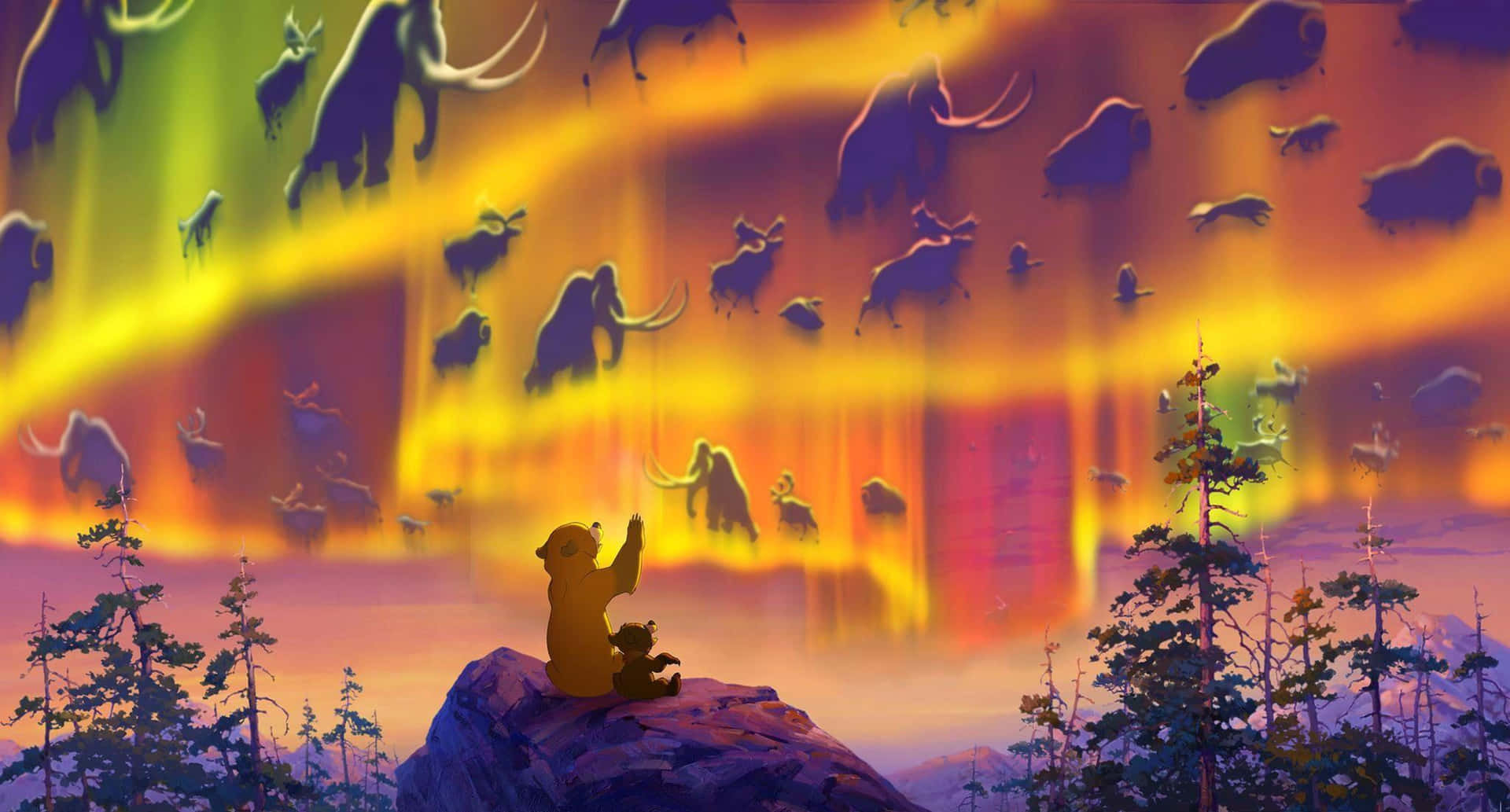
The Music of Brother Bear

Copyright © 2003 Disney Enterprises, Inc.

Songs by
Phil Collins

Score Composed by
Mark Mancina and Phil Collins

Music
Great Spirits
Produced and Arranged by Phil Collins and Mark Mancina
Performed by Tina Turner

Transformation
Produced and Arranged by Mark Mancina and Phil Collins
Choral Arrangement by Eddie Jobson
Performed by The Bulgarian Women’s Choir

On My Way
Produced and Arranged by Phil Collins and Mark Mancina
Performed by Phil Collins and Jeremy Suarez

Welcome
Produced and Arranged by Phil Collins and Mark Mancina
Additional Vocal Production by Chris Goldsmith
Performed by
The Blind Boys of Alabama and Phil Collins with Oren Waters

No Way Out (Theme from Brother Bear)
Produced and Arranged by Phil Collins and Mark Mancina
Performed by Phil Collins

Look Through My Eyes
Produced by Rob Cavallo
Arranged by Phil Collins and Rob Cavallo
Strings Arranged and Conducted by David Campbell
Recorded by Allen Sides
Mixed by Chris Lord-Alge
Performed by Phil Collins

No Way Out (Theme from Brother Bear) (Phil Collins Version)
Produced and Arranged by Phil Collins and Chris Montan
Mixed by Chris Lord-Alge
Performed by Phil Collins

Orchestrations by
David Metzger

Vocal Arrangements by
Phil Collins, Mark Mancina, David Metzger

Songs Recorded and Mixed by
Frank Wolf and Steve Kempster

Score Recorded and Mixed by
Steve Kempster

Music Editor
Earl Ghaffari

Music Production Supervisor
Tom MacDougall

Music Production Manager
Andrew Page

Music Production Coordinator
Deniece Hall

Technical Consultant
Chuck Choi

Orchestra Conducted by
Don Harper

Vocal Contractor
Carmen Carter and Bobbi Page

Songs Contracted by
Reggie Wilson

Score Contracted by
Sandy DeCrescent

Supervising Music Copyist
Booker White — Walt Disney Music Library

Assistant Music Editor
Daniel Gaber

Music Production Assistants
Joel Berke and Jill Iverson

Score Assistant
Johnny Whieldon

Transformation Inuit Translation
Lorena Kapniaq Williams

Choral Arrangements by
Eddie Jobson featuring The Bulgarian Women’s Choir

Phil Collins appears courtesy of Atlantic Records

Tina Turner appears courtesy of Parlophone / EMI Records Limited

The Bulgarian Women’s Choir appears courtesy of
Globe Music Media Arts Corp. / Jaro Medien GmbH

The Blind Boys of Alabama appear courtesy of
Real World Records, Ltd.

Rob Cavallo appears courtesy of Warner Bros. Records, Inc.

Soundtrack Available on
Walt Disney Records
Monday, October 21, 2024

Borderlands (John Fusco’s album)

Fusco’s third album

Recorded: 2021–22
Studio
  • Petit Jazz Studios, Vermont
  • Tank Recording Studio, Burlington, Vermont
Genre
  • Americana
  • Blues
  • Country
  • Gospel
  • Tex-Mex
Producer: George Walker Petit
Released: October 21, 2022; 2 years ago
Label: Rocket 88 Records
No. of Tracks: 10
Length: 49 minutes
Format: CD and Digital download

John Fusco — Composer, Lead Vocal, Piano, Hammond B3
George Walker Petit — Guitars, Bass, Percussion, Ocarina
Russ Lawton — Drums
Matthew Backer — Slide and Dobro Guitars
Patrick Richard Ross — Fiddle and Mandolin, Background Vocals
Ashley Betton — Background Vocals
Jane Boxall — Marimba
Stuart Paton — Congas
Connor Young — Trumpets
Michael Hartigan — Accordion

All songs/lyrics composed by John Fusco, except Ain’t No Grave (Traditional)

Engineered, produced, arranged, mixed by George Walker Petit at Petit Jazz Studio, Vermont
Additional engineering by Ben Collette at the Tank Studio, Vermont

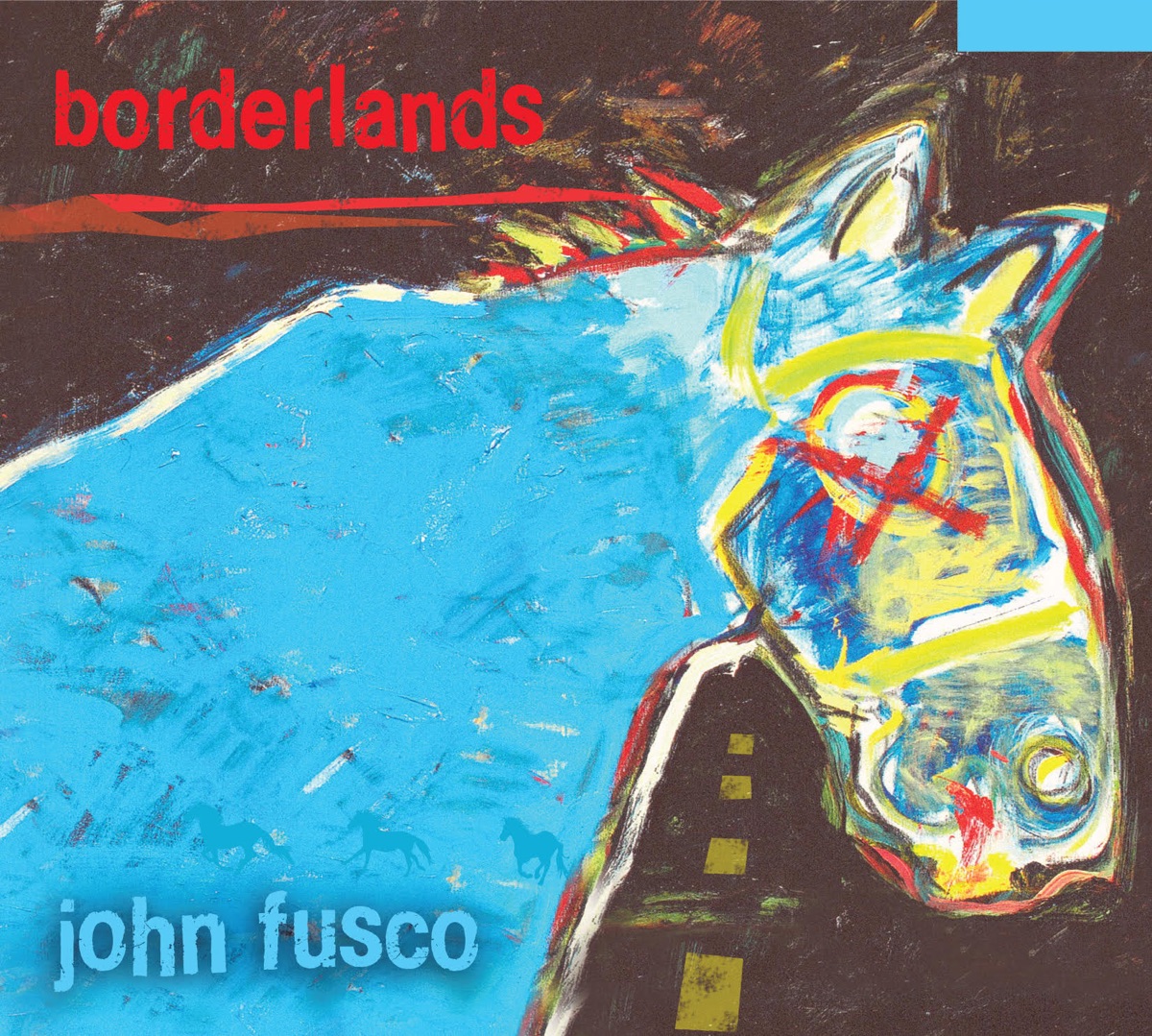
Cover Art by Tom Russell (tomrussell.com)
Graphic design by Mariah Parker (mettagraphics.com)

Coyote Man
John Fusco — Lead Vocal, Piano
George Walker Petit — Guitars, Fretless Bass, Percussion, Ocarina
Russ Lawton — Drums
Stuart Paton — Congas
Connor Young — Trumpets

Dance of the Seven Veils
John Fusco — Lead Vocal, Keyboards
George Walker Petit — Guitars, Fretless Bass, Percussion
Russ Lawton — Drums
Jane Boxall — Marimba
Stuart Paton — Hand Drums

Bad Luck Rides Shotgun
John Fusco — Lead Vocal, Hammond B3
George Walker Petit — Rhythm Guitar, Bass, Percussion
Russ Lawton — Drums
Matthew Backer — Slide Guitar, Rhythm Guitar

Horseback Jesus
John Fusco — Composer, Lead Vocal, Piano
George Walker Petit — Guitars, Bass
Michael Hartigan — Accordion

Cowboy Picture
John Fusco — Composer, Lead Vocal, Hammond B3
George Walker Petit — Guitars, Bass, Percussion
Russ Lawton — Drums
Patrick Richard Ross — Fiddle, Mandolin, Background Vocals

Countrified Noise
John Fusco — Composer, Lead Vocal
George Walker Petit — Guitars, Bass
Russ Lawton — Drums
Patrick Richard Ross — Fiddle, Mandolin

Cyanide Whisky
John Fusco — Composer, Lead Vocal, Hammond B3
George Walker Petit — Guitar, Bass, Percussion
Russ Lawton — Drums
Matthew Backer — Dobro, Slide Guitar, Trem & Rhythm Guitar

Knighted by the Queen
John Fusco — Composer, Lead Vocal
George Walker Petit — Guitars, Bass, Percussion
Russ Lawton — Drums
Jane Boxall — Marimba
Stuart Paton — Hand Drums
Ashley Betton — Background Vocals, Handclapse

Run, Rez Dog, Run
John Fusco — Composer, Lead Vocal
George Walker Petit — Guitars, Bass, Ocarina
Russ Lawton — Drums
Patrick Richard Ross — Fiddle, Mandolin, Background Vocals

Ain’t No Grave
John Fusco — Lead Vocal
George Walker Petit — Guitar, Fretless Bass
Ashley Betton — Background Vocals

Mil Gracias... by John Fusco
Many thanks to George Walker Petit, without whom this album wouldn’t have existed. You’re a true compadre, George, and I must say it again: Where have you been all my life? Along with George’s engineering, guitars, bass, and various percussion, I am grateful for the Borderlands posse of Russ Lawton, Patrick Ross, Matt Backer, and all the gifted players on this collection. Mil gracias to Oscar Zambrano and Zampol Productions, border troubadour and painter Tom Russell for the original cover art (Blue Horse), Charley Robinson of Iconoclast Design, Mariah Parker of Mettagraphics, and Groovehouse.

Friday, October 4, 2024

The Music of Tarzan (1999 film)

Copyright © 1999 Edgar Rice Burroughs, Inc. and Disney Enterprises, Inc.

Songs by
Phil Collins

Score Composed by
Mark Mancina

Executive Music Producer
Chris Montan

You’ll Be in My Heart (Phil Version)
Produced by Rob Cavallo and Phil Collins
Performed by Phil Collins
Recorded by Elliot Scheiner
Mixed by Chris Lord-Alge

Music
Two Worlds
Produced and Arranged by Phil Collins and Mark Mancina
Performed by Phil Collins
Orchestra Conducted by Mark Mancina

You’ll Be in My Heart
Produced by Mark Mancina and Phil Collins
Arranged by Mark Mancina
Vocals by Phil Collins and Glenn Close
Orchestra Conducted by Mark Mancina

Son of Man
Produced and Arranged by Phil Collins
Performed by Phil Collins

Trashin’ the Camp
Produced and Arranged by Phil Collins
Noises Performed by Phil Collins
Vocals by Rosie O’Donnell
Additional Musical Arrangements by Paul Bogaev

Strangers Like Me
Produced by Phil Collins
Arranged by Phil Collins and Mark Mancina
Performed by Phil Collins
Orchestra Conducted by Mark Mancina

Score Produced by
Mark Mancina

Orchestrations by
David Metzger

Score Conducted by
Don Harper

Songs Recorded and Mixed by
Frank Wolf

Score Recorded and Mixed by
Steve Kempster

Score Co-Produced by
Christopher Ward

Music Editor
Earl Ghaffari

Assistant Music Editors
Robbie Boyd and Daniel Gaber

Director, Music Production
Andrew Page

Music Production Manager
Tom MacDougall

Music Production Coordinator
Deniece LaRocca

Music Contractors
Sandy DeCrescent and Reggie Wilson

Vocal Contractors
Bobbi Page and Fonzi Thornton

Additional Synth Programming
Marc Mann

Supervising Music Copyist
Booker White - Walt Disney Music Library

Music Preparation by
JoAnn Kane Music Service

Phil Collins appears courtesy of Atlantic Records

Original Soundtrack Available on
Walt Disney Records
Tuesday, October 1, 2024

The Music of The Lion King

Copyright © 1994 The Walt Disney Company

Songs by
Tim Rice and Elton John

Original Score Composed and Arranged by
Hans Zimmer

Can You Feel the Love Tonight
Performed by Elton John
Produced by Chris Thomas

Music Supervision by
Hans Zimmer

Songs
Circle of Life
Arranged and Produced by Hans Zimmer
Performed by Carmen Twillie
African Vocals Performed by Lebo M.

I Just Can’t Wait to Be King
Arranged and Produced by Mark Mancina
Performed by Jason Weaver and Laura Williams with Rowan Atkinson

Be Prepared
Arranged and Produced by Hans Zimmer
Performed by Jeremy Irons
with Whoopi Goldberg, Cheech Marin and Jim Cummings

Hakuna Matata
Arranged and Produced by Mark Mancina and Jay Rifkin
Performed by Nathan Lane, Ernie Sabella,
Jason Weaver and Joseph Williams

Can You Feel the Love Tonight
Arranged and Produced by Mark Mancina
Performed by
Nathan Lane, Ernie Sabella, Sally Dworsky,
Joseph Williams and Kristie Edwards

Music Recorded and Mixed by
Jay Rifkin

Music Recorded at
Media Ventures (USA)
Todd-AO Scoring (USA)
Angel Studios (UK)
BOP Studios (South Africa)

Supervising Music Editor
Adam Milo Smalley

African Vocal Solos and Improvisations Created by
Lebo M.

Additional Song Arrangement
Bruce Fowler, Danny Troob, Paul Bogave

Additional Vocal Arrangement
Bruce Fowler, Bobbi Page, Mark Mancina

Score Conducted by
Nick Glennie-Smith

Score Orchestrations
Bruce Fowler

Additional Orchestrations
Ladd McIntosh and Yvonne Moriarty

Choral Arrangement and Conducting by
Lebo M., Andrae Crouch, Mbongeni Ngema, Nick Glennie-Smith

Choir Masters
Mbongeni Ngema and Andrae Crouch

Vocal Contractors
Tonia Davall, Mbongeni Ngema, Bobbi Page, Alfie Silas

Music Production Assistance by
Nico Golfar (USA), Maggie Rodford (UK), Eric Stark (South Africa)

Assistants to Hans Zimmer
Christopher Ward, Mitchell Lamm, Antonia Bogdanovich

Orchestra Contractor
Reggie Wilson

Orchestra Copyist
Dominic Fidelibus

Elton John appears courtesy of
MCA Records (USA and Canada) and Phonogram Ltd. (Rest of the World)

Mbongeni Ngema appears courtesy of Tusk Records

Circle of Life Chorus
Maxi Anderson
Baby Cele
Gugwana Dlamini
Linda Gcwensa
Kuyanda Jezile
Sphiwe Khanyile
Skhumbuzo Kubheka
James Langa
Tsidi Mayne
Myrna Matthews
Nonhlanhla Mkhize
Nandi Ndlovu
Bobbi Page
Philile Seme
Kipizane Skweyiya
Khuluiwe S’thole
Sam Vamplew
Maxine Waters
Yvonne Williams
Terry Bradford
Lucky Cele
Kevin Dorsey
Clydene Jackson
Bob Joyce
Faca Khulu
Thembi Kubheka
Edie Lehmann
Khanyo Maphumulo
Batho Mhlongo
Thembi Mtshali
Bongani Ngcobo
Phindile
Alfie Silas
Sindisiwe Sokhela
Thandazile
Julia Waters
Oren Waters
Terry Young
Johnny Britt
Rick Charles
Wendy Fraser
Matoab’sane Jali
Faith Kekana
Stella Khumalo
Ron Kunene
Rick Logan
Abner A. Mariri
Vusi Mhlongo
Bheki Ndlovu
Niki Nkosi
Rick Riso
Happy Skhakhane
Susan D. Stevens
Carmen Twillie
Luther N. Waters
John West
Zolile Zulu

Soundtrack Available
on Cassette and Compact Disc from
Walt Disney Records

Monday, September 30, 2024

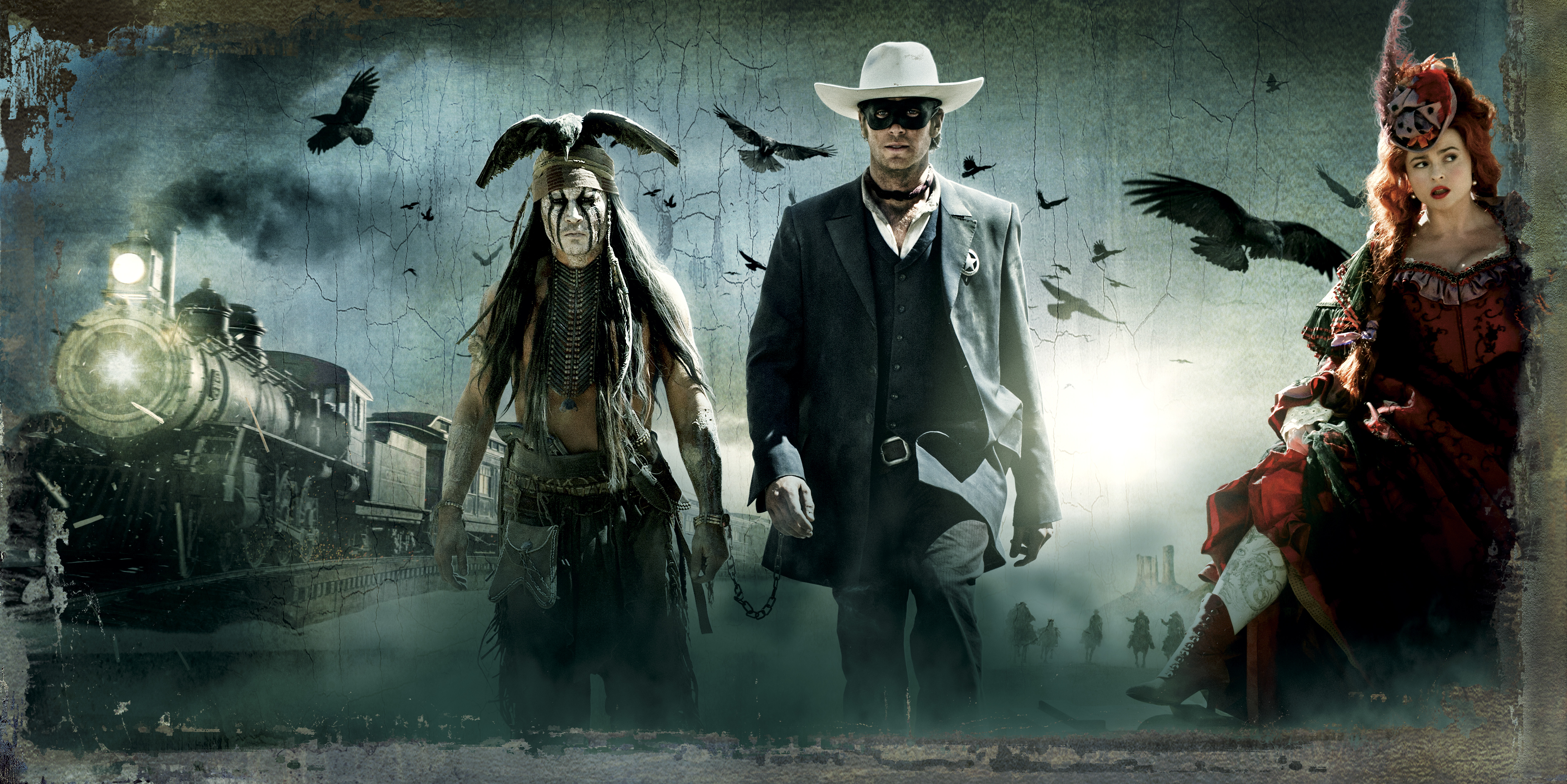
The Music of The Lone Ranger (2013 film)

Copyright © 2013 Disney Enterprises, Inc. and Jerry Bruckheimer, Inc.

Music by
Hans Zimmer

Supervising Music Editor
Kenneth Karman

Music Wrangler
Bob Badami

Music Editors
Peter Oso Snell and Katie Greathouse

Music Production Supervisor
Monica Zierhut

Additional Music by
Geoff Zanelli
Rupert Gregson-Williams
Steve Mazzaro
Andrew Kawczynski
Jasha Klebe
Lorne Balfe

Featured Musicians
Nico Abondolo
Jason Bonham
Ann Marie Calhoun
Anthony Clarke
Mike Einziger
Pedro Eustache
Aleksey Igudesman
Arturo Sandoval
Tristan Schulze

Supervising Orchestrator
Bruce Fowler

Orchestrations by
Walt Fowler, Kevin Kaska, Suzette Moriarty, Carl Rydlund

Music Preparation
Booker White — Walt Disney Music Library

Score Recorded by
Joel Iwataki

Score Mixed by
Daniel Kresco and Satoshi Noguchi

Digital Workstation Operators
Kevin Globerman and Vincent Cirilli

Orchestra Conducted by
Nick Glennie-Smith

Score Recorded at
Sony Scoring Stage and The Newman Scoring Stage

Score Recorded and Mixed at
Remote Control Studios

Orchestra Contractor
Peter Rotter

Concert Master
Belinda Broughton

Music Production Services
Steve Kofsky

Score Coordination for Remote Control Studios
Czarina Russell

Technical Assistants
Chuck Choi, Brian Wherry, Phill Boucher

Digital Instrument Design
Mark Wherry

Assistant Engineers
Christian Wenger, Tim Lauber, Adam Michalak

On-Camera Supervising Music Mixer
Joseph Magee

On-Camera Music Arranged by
Geoff Zanelli

Pre-Record Orchestrations by
Marshall Bowen, Dave Giuli, Jennifer Hammond

Vocal Contractor
Jasper Randall

After the Battle of Aughrim
Arranged by Hans Zimmer and Ann Marie Calhoun

Hanson Place (Shall We Gather at The River)
Arranged by Marshall Bowen

Battle Hymn of the Republic
Arranged by Geoff Zanelli

Red’s Theater of the Absurd
Written and Produced by Jack White
Performed by Pokey LaFarge and the South City Three

Beautiful Dreamer
Arranged and Produced by Jack White
Performed by Pokey LaFarge and the South City Three

The Girl in the Flying Trapeze
Arranged and Produced by Jack White
Performed by Pokey LaFarge and the South City Three

Dixie
Arranged by Kenneth Karman

Stars and Stripes Forever
Written by John Philip Sousa
Arranged by Geoff Zanelli

Marse Henry March
Arranged by Geoff Zanelli

The Star Spangled Banner
Written by Francis Scott Key
Arranged by Geoff Zanelli

William Tell Overture
Arranged by Geoff Zanelli

Soundtrack Available on
Walt Disney Records
Wednesday, September 25, 2024

The Music of Pearl Harbor (2001 film)

Copyright © 2001 Touchstone Pictures and Jerry Bruckheimer, Inc.

Music by
Hans Zimmer

Music Supervisors
Bob Badami and Kathy Nelson

Music Editor
Jennifer Nash

Assistant Music Editor
Katie Greathouse

Music Production Services by
Media Ventures

Score Recorded and Mixed by
Alan Meyerson

Score Conducted by
Gavin Greenaway

Supervising Orchestrator
Bruce Fowler

Orchestrations by
Elizabeth Finch, Walter Fowler, Ladd McIntosh, Suzette Moriarty

Concertmaster
Andre Granat

Soprano Solos by
Julia Migenes

Additional Recording by
Slamm Andrews

Additional Arrangements
Fiachra Trench
Klaus Badelt
Steve Jablonsky
James S. Levine
Geoff Zanelli

Assistant Engineers
Gregg Silk and Kevin Globerman

Score Stage Recordist
John Rodd

Score Recorded at
Newman Scoring Stage

Music Contractor
Sandy DeCrescent

On-Camera Production Music Recorded by
Joseph Magee

Production Music Recorded at
Signet Sound Studios

Music Preparation by
Booker White — Walt Disney Music Library

There You’ll Be
Written by Diane Warren
Produced by Trevor Horn and Byron Gallimore
Performed by Faith Hill
Courtesy of Warner Bros. Records

Soundtrack Available on
Hollywood / Warner Bros. Records

Thursday, September 5, 2024

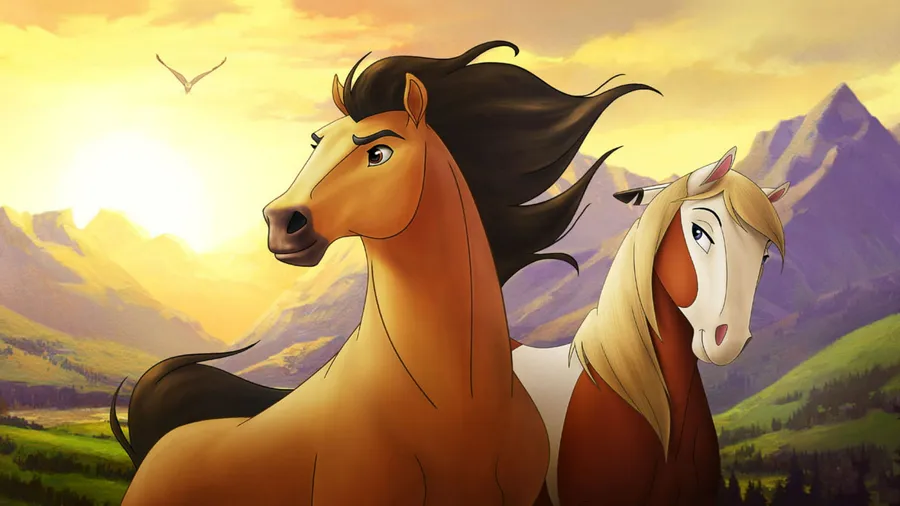
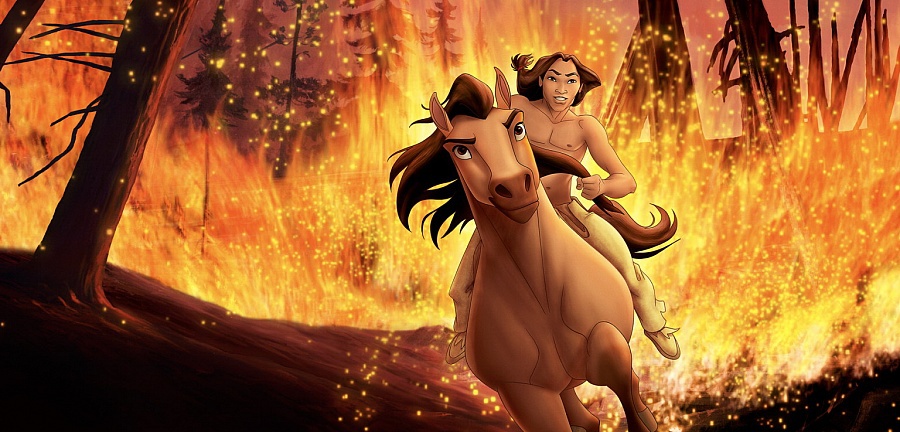
Production Notes of Spirit: Stallion of the Cimarron


Date of Production: 1998-2002

DreamWorks Pictures newest animated feature, Spirit: Stallion of the Cimarron, is both an artistic and technical marvel, and illustrates that what is regarded these days as traditional animation, is anything but traditional. The advent of the computer in animation has revolutionized the genre, perhaps most notably with the inauguration of entirely computer-animated films. However, the computer has also had an ever-increasing impact on 2D, traditional animation.

Surprisingly, for all its painterly qualities, Spirit: Stallion of the Cimarron is DreamWorks most technologically complex animated film of any kind to date.

The thing that is unique to traditional animation is what happens when an artist, an animator, gives life to a character with his or her own hand,” producer Jeffrey Katzenberg offers. “It’s a direct creation of life with a pencil on a piece of paper. Computers can't do that… not yet.” But, Katzenberg adds, “The computer is not the nemesis of traditional animation. What I wanted to do with this film was to take hand-drawn animation and marry it together with state of the art technology to create a film that is the best of both worlds.”

Spirit: Stallion of the Cimarron is by no means the first traditionally animated film to incorporate computer-animated elements. However, this movie represents such a wholesale commingling of these two techniques, that some of the production team have referred to it as a hybrid form of animation. The primary example of this hybrid comes early on in the film, as we see the adult Spirit running with his herd. As they run, we are watching 3D animation not only of the herd, but also of Spirit himself. As Spirit comes up to the crest of a hill, the camera zooms in to circle around him, and we witness, but don’t see, an absolutely imperceptible 2D takeover of the shot. Then, as the camera moves back, there is another takeover, this time 3D, that is equally seamless.

Whether 2D or 3D, horses are notoriously difficult to draw and even more so to animate, which speaks to why Spirit: Stallion of the Cimarron is the first animated film to feature a horse as its central character.

There are several elements that have kept horses off the drawing boards of animators. They have a long, inflexible spine, a defined musculature seen in every movement and a wide range of gaits. Their faces also pose another kind of challenge, characterized by an elongated muzzle, with the eyes set high and wide and the mouth set low.

The entire animation team began an intensive crash course on equine anatomy, movement, locomotion and behavior. At the Los Angeles Equestrian Center, the animators spent hours studying and sketching real horses. The animators also benefited enormously from the expertise of two of the horse world’s most respected authorities and the film’s horse consultants, Dr. Deb Bennett and Dr. Stuart Sumida.

The doctors engaged the animators in a multi-pronged training program, teaching them about horses from the inside out. 
Aside from the fact that horses have that long, rigid spine, other parts of their anatomy are almost always moving, from the long neck that bends and swings and the tail that flicks and swishes, to the ears that pivot to capture sound and the lips that serve as their “hands”.

The animation team was further educated about the varying gaits of a horse - walk, trot, canter 
and full gallop. More than just the speed, animators had to learn the individual components of each gait and the emotions behind them. For example, the frolicking gallop of a horse at play is entirely different from a gallop instigated by fear.

One special character in Spirit: Stallion of the Cimarron is neither horse nor human. It is the landscape of the American West itself, at a time when the frontier was as untamed as the wild mustangs that called it home.

The progress of civilization has forever changed much of the landscape, so production designer Kathy Altieri, art directors Ron Lukas and Luc Desmarchelier and the filmmakers began their research in books about the Old West. They also watched old movie Westerns and studied the paintings of the great Western artists, like Frederic Remington, Frank Tenney Johnson and James Reynolds.

But no painting, movie or photograph could be as inspirational to the filmmakers and design team as seeing firsthand the still-breathtaking vistas of the West. So eight members of the production team embarked on a whirlwind tour of eight of America’s most treasured national parks in only four days.

Glacier National Park became the model for Spirit’s homeland, with its magnificent landscape 
of lush green grass, open blue skies and rolling hills and valleys. In sharp contrast, the Cavalry fort was a re-creation of Monument Valley where the terrain is stark and more angular.

Aspects of both Yosemite National Park and Yellowstone National Park are seen in the Lakota village where Spirit meets his love Rain. Bryce Canyon, with its unique rock formations towering above narrow, winding trails, provides the perfect 
backdrop for the heart-stopping chase scene. To do the panoramic vistas of the American West justice on the screen, the filmmakers felt their only choice was to shoot Spirit: Stallion of the Cimarron in the wide-screen format Cinemascope. For the animation team, the decision meant they would be required to produce 40 percent more animation to fill the larger frames. At 24 frames per second, this translated to a great deal of work for both the traditional animators and the digital artists.

At the start of the film, the audience is carried into the world of Spirit on the wings of an eagle in what the production team dubbed the “homeland pan.” The shot is a three-minute camera fly through capturing some of the most recognizable landmarks of the American West, in what appears to be one long, continuous pan. Actually comprised of seven separate parts, the sequence features a perfect blending of hand drawn-characters and traditionally painted backdrops with digital environments and CG characters.

More than nine months in just the design stage, the homeland pan was one of the first sequences to go into production and one of the last to be finished. Achieving the exceedingly complex shot required literally tens of thousands of 2D and 3D elements, including more than 700 traditionally painted backgrounds and more than 2,500 drawings, another 1,800-plus painted elements that were then texture mapped onto 3D geometry to make the virtual sets and more than 12,000 frames of computer-generated elements. There were an average of 30 layers composited to produce any given frame, and the fly through involved 4,183 final film frames.

Wednesday, August 28, 2024

Power Rangers (TV series)

BVS Entertainment, Inc. and BVS International N.V.

Disney acquired Power Rangers, and the brand’s merchandising rights, when the company purchased Fox Family Channel in 2001. Power Rangers Ninja Stormwhich debuted in 2003, was the first production solely managed by Disney. Production moved to New Zealand and included a new producer, cast, and crew. Power Rangers first appeared on American television in 1993. Production on new episodes ceased in 2009, and the franchise was sold to Saban Brands, the original owner, on May 12, 2010.

Created by Haim Saban and Shuki Levy
Original work: Mighty Morphin Power Rangers
Based on the Japanese television series Super Sentai by Shotaro Ishinomori
Owner
  • Toei Company, Ltd.
  • Saban Entertainment, Inc. (1993–2001)
  • The Walt Disney Company (2001–10)
No. of Seasons: 17 (My List)
No. of Episodes: 700 (My List)

Television (My List)
1993–96: Mighty Morphin Power Rangers
1996: Power Rangers Zeo
1997: Power Rangers Turbo
1998: Power Rangers in Space
1999: Power Rangers Lost Galaxy
2000: Power Rangers Lightspeed Rescue
2001: Power Rangers Time Force
2002: Power Rangers Wild Force
2003: Power Rangers Ninja Storm
2004: Power Rangers Dino Thunder
2005: Power Rangers S.P.D.
2006: Power Rangers Mystic Force
2007: Power Rangers Operation Overdrive
2008: Power Rangers Jungle Fury
2009: Power Rangers RPM

Thursday, August 8, 2024

The Music of Spirit: Stallion of the Cimarron

Copyright © 2002 DreamWorks LLC

Music by
Hans Zimmer

Songs by
Bryan Adams

Artistic Music Supervisor
Marylata E. Jacob

Executive Music Producer
Jay Rifkin

Assistants to Hans Zimmer
Moanike’ala Nakamoto and Clay Duncan

Music Assistant
Julie Imboden

Music
Additional Music by
Steve Jablonsky

Supervising Music Editor & Music Recorded by
Slamm Andrews

Music Editor
Robb Boyd

Songs Mixed by
Bob Clearmountain

Score Mixed by
Alan Meyerson

Studio Assistants
Kevin Churko, Kevin Harp, Kevin Globerman, Gregg W. Silk

Technical Music Advisers
Kazimir Boyle, Melissa Muik, Trevor Morris, Joel Richard

Music Production Services
Thomas Broderick; Media Ventures, Los Angeles

Orchestra Recorded at
Air Lyndhurst Studios, London

Orchestra Recorded by
Geoff Foster

Assisted by
Michael Price, Jake Jackson, Adam Noble

Music Conducted by
Gavin Greenaway

Concertmaster
Perry Montague Mason

Music Copyist
Tony Stanton

London Musician Contractor
Tonia Davall

Orchestra Score Recording Supervised by
Maggie Rodford; Air-Edel Associates Ltd.

Red River Valley
Arranged by Craig Eastman

Additional Arrangements
Jim Dooley, Rupert Gregson-Williams, Mel Wesson

Solo Guitar
Heitor Pereira

Songs
Here I Am
Written by Bryan Adams, Gretchen Peters, Hans Zimmer
Produced by Gavin Greenaway and Bryan Adams

This is Where I Belong
Written by Bryan Adams, R.J. Lange, Hans Zimmer
Produced by Gavin Greenaway and Bryan Adams

You Can’t Take Me
Written by Bryan Adams, Gavin Greenaway, R.J. Lange
Produced by Gavin Greenaway and Bryan Adams

Get Off My Back
Written by Bryan Adams, Eliot Kennedy
Produced by Matt Mahaffey and Bryan Adams

Sound the Bugle
Written by Gavin Greenaway, Trevor Horn
Produced by Gavin Greenaway

I Will Always Return (Finale)
Written by Bryan Adams, R.J. Lange, Hans Zimmer
Produced by Gavin Greenaway and Bryan Adams

Here I Am (End Title)
Produced by Jimmy Jam and Terry Lewis
for Flyte Tyme Productions, Inc.

Don’t Let Go
with Sarah McLachlan
Written by
Bryan Adams, Gavin Greenaway, R.J. Lange, Gretchen Peters
Produced by Gavin Greenaway and Bryan Adams

Brothers Under the Sun
Written by Bryan Adams, Steve Jablonsky, Gretchen Peters
Produced by Steve Jablonsky and Bryan Adams

Soundtrack Available on
A&M Records / UMG Soundtracks

Tuesday, May 14, 2024

Spirit: Stallion of the Cimarron (Music from the Original Motion Picture)

The album cover is made in Europe

Recorded: 2001–02
Studio
  • Media Ventures, Los Angeles
  • Air Lyndhurst Studios, London
  • The Warehouse Studio, Vancouver
  • The Warehouse Studio Mobile Unit, Jamaica
  • Compass Point, Bahamas
Executive Music Producer: Jay Rifkin
Released: May 14, 2002
Label: A&M Records / UMG Soundtracks (Universal Music Group)
Length: 59 minutes
Format: CD

Here I Am
(Bryan Adams, Gretchen Peters, Hans Zimmer)
Produced by Jimmy Jam and Terry Lewis for Flyte Tyme Productions, Inc.
Engineered by Steve Hodge and Kevin Globerman
© 2002 Badams Music Limited (ASCAP); SKG Songs (ASCAP)

I Will Always Return
(Bryan Adams, R.J. Lange, Hans Zimmer)
Produced by Patrick Leonard and Bryan Adams
Additional Production by Gavin Greenaway
Engineered by Michael Verdick, Kevin Globerman, Kevin Churko
Additional Engineering by David Channing and Terry Manning
Assisted by Katrina Leigh and Brian Vibberts
© 2002 Badams Music Limited (ASCAP); Zomba Enterprises, Inc. (ASCAP); SKG Songs (ASCAP)

You Can’t Take Me
(Bryan Adams, Gavin Greenaway, R.J. Lange)
Produced by Gavin Greenaway and Bryan Adams
Engineered by Slamm Andrews
© 2002 Badams Music Limited (ASCAP); SKG Songs (ASCAP); Zomba Enterprises, Inc. (ASCAP)

Get Off My Back
(Bryan Adams, Eliot Kennedy)
Produced by Matt Mahaffey and Bryan Adams
Whistling, drums, BV’s and keyboards: Matt Mahaffey
Matt Mahaffey appears courtesy of DreamWorks Records
© 2002 Badams Music Ltd. (ASCAP); SKG Songs (ASCAP); Songs of SKG (BMI)

Brothers Under the Sun
(Bryan Adams, Steve Jablonsky, Gretchen Peters)
Produced by Steve Jablonsky and Bryan Adams
Engineered by Kevin Globerman, Slamm Andrews, Phil Western
© 2002 Badams Music Limited (ASCAP); Songs of SKG (BMI); SKG Songs (ASCAP)

Don’t Let Go (with Sarah McLachlan)
(Bryan Adams, Gavin Greenaway, R.J. Lange, Gretchen Peters)
Produced by Gavin Greenaway and Bryan Adams
Engineered by Kevin Globerman, Joel Richard, Chris Potter, Kevin Churko
Drums: Ashwin Sood / Acoustic Piano: Sarah McLachlan
Sarah McLachlan appears courtesy of Arista Records / Nettwerk Productions
© 2002 Badams Music Limited (ASCAP); SKG Songs (ASCAP); Zomba Enterprises, Inc. (ASCAP)

This is Where I Belong
(Bryan Adams, R.J. Lange, Hans Zimmer)
Produced by Gavin Greenaway and Bryan Adams
© 2002 Badams Music Limited (ASCAP); Zomba Enterprises, Inc. (ASCAP); SKG Songs (ASCAP)

Here I Am
(Bryan Adams, Gretchen Peters, Hans Zimmer)
Produced by Gavin Greenaway and Bryan Adams
© 2002 Badams Music Limited (ASCAP); SKG Songs (ASCAP)

Sound the Bugle
(Gavin Greenaway, Trevor Horn)
Produced by Gavin Greenaway
© 2002 SKG Songs (ASCAP); Unforgettable Songs Limited (PRS) / SPZ Music Inc. (BMI); Songs of SKG (BMI)

Run Free
(Hans Zimmer)
Produced by Hans Zimmer and Jay Rifkin
© 2002 SKG Songs (ASCAP)

Homeland (Main Title)
(Hans Zimmer)
Produced by Hans Zimmer and Jay Rifkin
© 2002 SKG Songs (ASCAP)

Rain
(Hans Zimmer)
Produced by Hans Zimmer and Jay Rifkin
© 2002 SKG Songs (ASCAP)

The Long Road Back
(Hans Zimmer)
Produced by Hans Zimmer and Jay Rifkin
© 2002 SKG Songs (ASCAP)

Nothing I’ve Ever Known
(Bryan Adams, Eliot Kennedy, Hans Zimmer)
Produced by Hans Zimmer, Gavin Greenaway and Bryan Adams
© 2002 Badams Music Limited (ASCAP); Songs of SKG (BMI); SKG Songs (ASCAP)

I Will Always Return (Finale)
(Bryan Adams, R.J. Lange, Hans Zimmer)
Produced by Gavin Greenaway and Bryan Adams
© 2002 Badams Music Limited (ASCAP); Zomba Enterprises, Inc. (ASCAP); SKG Songs (ASCAP)

Executive Film Music Producer: Jay Rifkin
Music Supervisor: Marylata E. Jacob
Additional Music by Steve Jablonsky
Supervising Music Editor: Slamm Andrews
Music Editor: Robb Boyd
Music Recorded by Slamm Andrews
Songs Mixed by Bob Clearmountain
Assisted by Kevin Harp
Film Score Mixed by Alan Meyerson
Studio Assistants: Kevin Churko, Kevin Globerman, Gregg W. Silk
Technical Music Advisors: Kazimir Boyle, Trevor Morris, Melissa Muik, Joel Richard
Music Production Services: Tom Broderick and Media Ventures, Los Angeles
Orchestra Recorded at Air Lyndhurst Studios, London
Orchestra Recorded by Geoff Foster
Assisted by Michael Price, Jake Jackson, Adam Noble
Orchestra Conducted by Gavin Greenaway
Concertmaster: Perry Montague Mason
Music Copyist: Tony Stanton
Music Business Affairs: Lenny Wohl
London Musician Contractor: Tonia Davall
Orchestral Score Recording Supervised by Maggie Rodford and Air-Edel Associates Ltd.
Additional Arrangements: Jim Dooley, Rupert Gregson-Williams, Mel Wesson
Assistants to Hans Zimmer: Moanike’ala Nakamoto and Clay Duncan
Music Coordination: Julie Imboden
Soundtrack Coordination: Anthony Seyler
Soundtrack Art Direction / Design: Terry Robertson
Photograph by Bryan Adams

Bryan Adams recorded at
The Warehouse Studio, Vancouver (www.warehousestudio.com)
The Warehouse Studio Mobile Unit, Jamaica
Compass Point, Bahamas

Musicians
Bass, Acoustic and Electric Guitar: Bryan Adams
Guitar: Keith Scott
Drums: Mickey Curry
Acoustic and Electric Guitar: Heitor Pereira
Electric Guitar: Davey Johnstone
12 String Guitar: David Channing
Electric Cello: Martin Tillman
Fiddle: Craig Eastman
Background Vocals: Pointless Brothers (Bryan Adams and R.J. Lange)
Keyboards and Programming: Gavin GreenawayPat LeonardSteve JablonskyHans Zimmer, Mel Wesson

Management: Bruce Allen
Assistant to Bryan Adams: Kathryn Appleton
Bryan Adams newsletter: Suite 500 - 425 Carrall Street, Vancouver, BC V6B 6E3, Canada

Motion Picture Artwork, Photos: ™ & © 2002 DreamWorks L.L.C.

Hans Zimmer would like to thank: Kelly Asbury, Lorna Cook, Jeffrey Katzenberg, David Geffen, Steven Spielberg, Max Howard, Mireille Soria, Bryan Adams, Guy Babylon, Klaus Badelt, Anna Behlmer, James Beshears, Tim Chau, Ronni Chasen, Craig Eastman, Nick Fletcher, Stacey Gellert, Nick Glennie-Smith, Michael Gorfaine, Gavin Greenaway, Harry Gregson-Williams, Bart Hendrickson, Vicki Hiatt, Todd Homme, Trevor Horn, Marylata “Duchess of Music” Jacob, Will Jennings, Jewel, Chris Johnson, Davey Johnstone, Robyn Klein, Kosta Kotselas, Adrian Lee, Henning Lohner, Andy Nelson, Terry Press, Phil Roy, Manfred Rürup, Denis St. Amand, Sam Schwartz, Martin Tillman, Diane Warren, Jake Zimmer, Suzanne Zimmer, Zoë Zimmer, Mini-Z’s, Jay Rifkin and the Media Ventures team.

Thank you very much (from Bryan Adams): Jeffrey Katzenberg, “Mutt” Lange, Hans Zimmer, Gavin Greenaway, Gretchen Peters, Eliot Kennedy, Jimmy Jam, Terry Lewis, Steve Hodge, Slamm Andrews (Iamslamm.com), Pat Leonard, Joey Issa, Kelly Asbury, Lorna Cook, Mireille Soria, Marylata Jacob, Jimmy Iovine, Ron Fair, Michael Ostin, Don Passman, Gregg Harrison, Bob Clearmountain, Tony Seyler, Jay Rifkin, Sam Schwartz, Shania Twain, Henning Lohner, Evil Wenches, Jody Perpick, Roy Lamb, Toe, Robert Nevalainen, Lance Stadnyk, Kim Blake, Sandee Bathgate, Randy Berswick, Nancy Emery, Manu Luyton, Heather McRitchie, Teri Tkachuk, Sarah McLachlan, Ashwin Sood, Terry McBride, Vicki Hiatt, Stacey Gellert, Matt Damon, Martin Kierszenbaum, Tomoko Itoki, David Rose, Lucian Grainge and all the staff at DreamWorks and Media Ventures for their huge efforts in putting this film and soundtrack together.


Phonographic Copyright: A&M Records
© 2002 A&M Records, Inc.
Printed in the U.S.A.

Album Information
February 24, 2004: Gold — Over 500,000 copies sold (RIAA)

Find Yourself (Brad Paisley’s song)

When you find yourself In some far off place And it causes you To rethink some things You start to sense That slowly you’re becoming someone...